February 12th, 2026
- Philippe Selot
- Feb 12
- 4 min read
Over the past few weeks, my schedule has included one fixed, unavoidable appointment: twice a week, I visit a wound-care specialist. It is a routine I had not planned for, but one that became necessary after a complication related to a stitch. The stitch could only be removed with difficulty and, to put it very concretely, it left a cavity in my leg.
In such a situation, simply placing another stitch would be counterproductive. It would create a closed space, ideal for the proliferation of germs. Before any tissue reconstruction could even be considered, one step proved essential: treating the wound and, above all, preventing the spread of germs. Without a healthy foundation, no curative breakthrough is possible.
The chosen approach surprised more than one observer. There was no heavy medication and no standardised solution, but rather a deliberately non-conventional method: honey and copper compresses. A combination that evokes a beehive and a craftsman’s workshop more than a highly technical hospital setting… and yet.
The results speak for themselves. Redness around the scar decreased significantly, inflammatory signs subsided, and the wound environment once again became conducive to healing. In other words, the ground was finally ready. It was at this precise moment that tissue reconstruction could begin. Not in haste, but on solid foundations, with a calm wound and a reactivated healing process. Proof that the most effective solutions are not always the most complex.
The chosen approach is therefore more subtle: allowing the tissues to rebuild gradually from the inside out. A strategy based on patience, supported by technology.
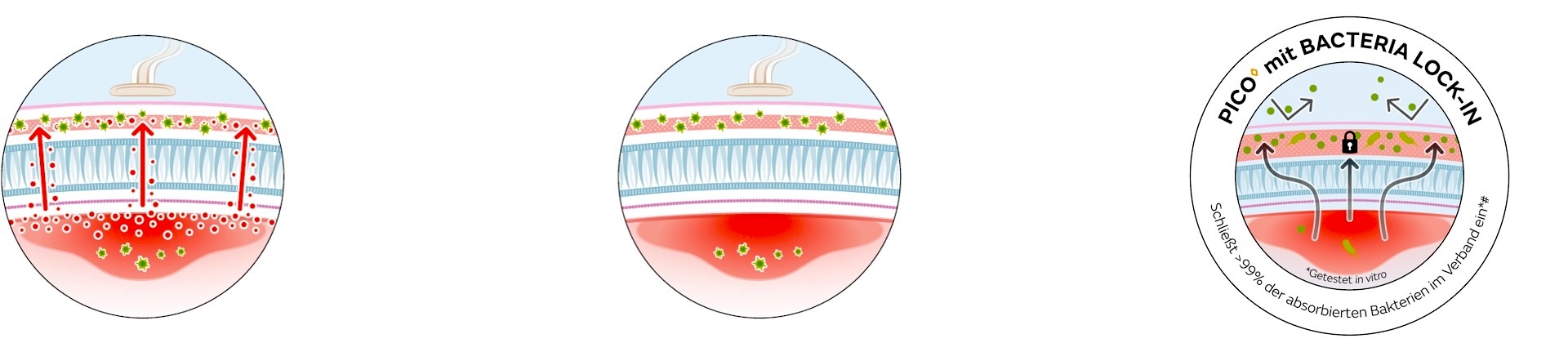
To support and speed up this process, a vacuum dressing was applied last Monday. Combined with a small pump, it absorbs wound secretions and effectively stimulates the formation of new tissue. No cause for concern: the technology is discreet. The pump is barely larger than a matchbox, completely silent, and easily fits into a trouser pocket. In other words, modern medicine also knows how to make itself unobtrusive.
Everything is therefore being done to optimise healing and promote recovery as quickly as possible. At night, however, the situation changes slightly. I sometimes experience violent spasms in my foot and leg, strong enough to have already torn the bed linen. Needless to say, these episodes wake me abruptly. After three or four spasms, things settle down, but diffuse, moderate, yet clearly noticeable pain then remains in my foot.
A question then crosses my mind: are these repeated contractions truly without consequence for the screws and plates firmly installed in my leg? To prevent this type of episode, I take Pregabalin, a medication used in particular to treat epilepsy, but also effective for this type of condition. I take it before going to sleep. Unfortunately, its effect wears off after a few hours… precisely at the moment when the spasms decide to make their appearance.
It was therefore with a mixture of apprehension and nervousness that I went to the orthopaedic centre today. The programme was clear: first, X-rays; then an examination of the scar and the effectiveness of the vacuum dressing by the wound-care specialist. Finally, the key moment: the arrival of the surgical team that operated on me, tasked with interpreting the X-ray images, assessing the situation, and defining the next steps. A dense, technical, but essential appointment and a new stage in this journey in which patience, technology, and a healthy dose of humour are clearly part of the treatment.
Professor Krause enters the room first. As so often in moments like these, I try to read the verdict on his face. Mission impossible. A neutral expression, perfectly controlled. No clue.
After the customary greetings, he asks a simple question: “How are you? Are you in pain?”
A seemingly ordinary question. Yet in a postoperative context, it can trigger a thousand scenarios. Why ask this if everything is supposed to be fine? My mind, always very cooperative in such situations, immediately prepares for the worst.
I tell him that I am not in pain. Apart from the limited mobility and the nighttime spasms (which are under control with medication), I am doing well.
His response comes, clear and factual: he is satisfied as well.
Immediate relief!
The X-rays confirm the clinical examination. No visible problems. The hardware is in place, the alignment is correct, and bone consolidation is progressing as expected. Technically speaking: everything is exactly where it should be.
The instructions, however, remain strict. Weight-bearing on the foot must be limited to a maximum of 20 kilograms. In other words: not much. The cast will remain in place at least until the end of March. The stability achieved must be protected with discipline.
It has been a long time since I felt this happy and relieved. But euphoria must not replace vigilance. Bone healing tolerates neither impatience nor excessive optimism. The rule remains simple: do not load the foot. At this stage, using my scooter as an alternative to crutches greatly facilitates compliance with the restrictions. It provides more stability, less fatigue, and reduces the risk of incorrect movements. As it turns out, the most useful innovation is not always the most spectacular.
To complete this already positive picture, next week will be rich in visits. Marco, my colleague from Zurich, will stop by on Monday. René, from Cologne, will be here from Wednesday to Friday before continuing on to Lucerne. Deniz returns tomorrow and will likely join me over the weekend. Together, we need to move forward with several administrative steps related to his scholarship.
Between rigorous medical follow-up and the support of friends, recovery takes on a far more human dimension. In short: discipline maintained, prognosis favourable… and morale at its highest.
Deniz sent me also a few pictures from the market in Dersim. You get the feeling that you’re more in the Orient than in the Occident.
HAPPY!






Comments