April 2, 2026
- Philippe Selot
- Apr 5
- 4 min read
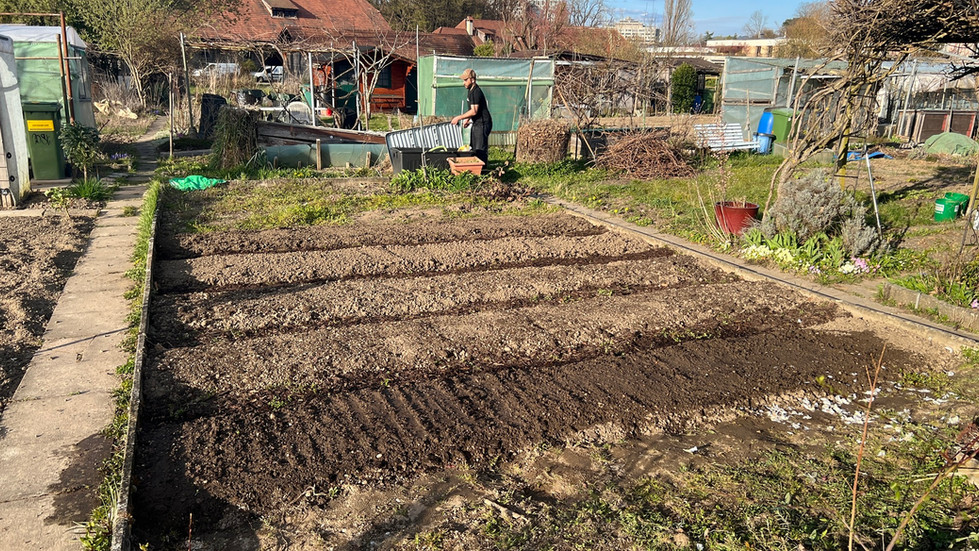
Today, on this Good Friday, Switzerland moves at a slower pace. In most cantons, it is a public holiday. The sky is clear, the light is beautiful, yet the air remains cool, one of those early spring days that gently invites you outdoors. Around midday, Deniz arrives. Without wasting any time, he gets to work in the garden. The objective for the afternoon is clear: to prepare the beds for planting vegetables. The soil is still compact after the winter, but it is beginning to loosen. Turning the soil, removing old roots, airing the surface, and adding compost and fertiliser (horn shavings) all essential steps that lay the groundwork for what comes next. He planted onions and garlic. That does not diminish the value of the day. On the contrary, preparing the ground now is an investment in the weeks ahead. And, truth be told, working in the sunshine, even with slightly cold fingers, is always more pleasant than staying indoors.
Last Thursday, I had my final appointment with the wound care specialist, an important milestone that, this time, genuinely feels like progress. For the past week, a simple dressing has been sufficient to protect a scar which, it must be said, has had a somewhat eventful journey. The reason? A suture that could not be removed easily and slowed down the healing process. Proof, if ever it were needed, that even the smallest details can sometimes lead to the longest stories…
For the past few days, the neuropathic pain in my foot has increased; at times it is very severe.
The next step is already in sight: next Wednesday, I have an appointment with the surgeon, preceded by X-rays to ensure that everything is perfectly in place. If all goes as expected, it will mark the end of one chapter and, most importantly, after three months, the long-awaited removal of the cast. A separation I certainly will not regret… even if we have, in a way, grown rather familiar with one another.
Beyond its medical dimension, this experience echoes many situations I have encountered throughout my professional life. I have had the privilege of meeting inspiring individuals who helped me grow, become more effective, and above all, find fulfilment in my work. Their high standards were constructive, their attitude supportive. For that, I remain deeply grateful.
But as in any organisation, there is also another side: behaviours that are more rigid, sometimes disconnected, or even counterproductive. Recent exchanges with Deniz provide a very tangible example. They serve as a reminder of a universal reality: in every professional environment, there are forces that drive progress and others that hold it back. Deniz recently had a very constructive meeting with the principal of his institution. At the heart of the discussion was a recurring issue involving a teacher who does not comply with the established rules regarding the language of instruction. In German-speaking Switzerland, the framework is clear: from secondary level onwards, lessons must be conducted in standard German. Dialect has its place in informal exchanges and is an integral part of the culture, but it cannot replace the language of instruction in an academic setting.
Despite this clearly defined framework, the teacher continues to use dialect in class. At times, the situation goes further: when Deniz reminds her of the need to use standard German, she responds with remarks tinged with sarcasm, which may be perceived as demeaning. She justifies her position by a desire to preserve local cultural specificities. This intention is laudable and reflects a genuine attachment to linguistic heritage. However, it reaches its limits when it contradicts clearly established official guidelines. This misalignment creates avoidable tension. The objective is not to oppose culture and institutional frameworks, but to strike a balance. In this case, however, the rules leave little room for interpretation, even if dialect may sometimes feel more natural than the standard language.
This situation is reminiscent of certain experiences in the corporate world. When I worked within a German group, several colleagues joined our teams in Switzerland. Out of respect and for the sake of clarity, we consistently used standard German in professional exchanges, even where dialect was commonly encouraged in daily interactions. Quite simply, it was a matter of professionalism.
The exchange between Deniz and the Dean took place in a constructive and respectful atmosphere. What remains to be seen is the extent to which the rules will be applied consistently and sustainably in day-to-day practice. Ultimately, the issue goes beyond language alone. It concerns respect for established frameworks, the quality of education, and equal opportunities for all students. No one can place themselves above the law, and it is precisely this consistency that ensures the credibility of the system as a whole.
Finally, this reflection sits within a broader context. As in many European countries, the healthcare sector in Switzerland is facing a significant shortage of staff. A public vote held a few years ago aimed precisely to improve working conditions and strengthen the attractiveness of these essential professions.
In this context, every stakeholder in education has a key role to play. Transmitting knowledge is one thing; inspiring, motivating, and enhancing the value of a profession is another, equally essential. When a teacher loses sight of this responsibility, questions about their role naturally arise.
In the end, whether in medicine, education, or management, the same lesson applies: quality often lies in attention to detail and in the attitude adopted each day. If a single suture can delay healing, an inappropriate mindset can just as easily hinder progress far more than one might imagine. And ultimately, it is quite simple: it is a matter of respect.
Happy Easter to everyone!




Comments